

Out of Uniform Detection
Dress compliance enforced continuously — on every camera, every shift — not just at the door at shift start.

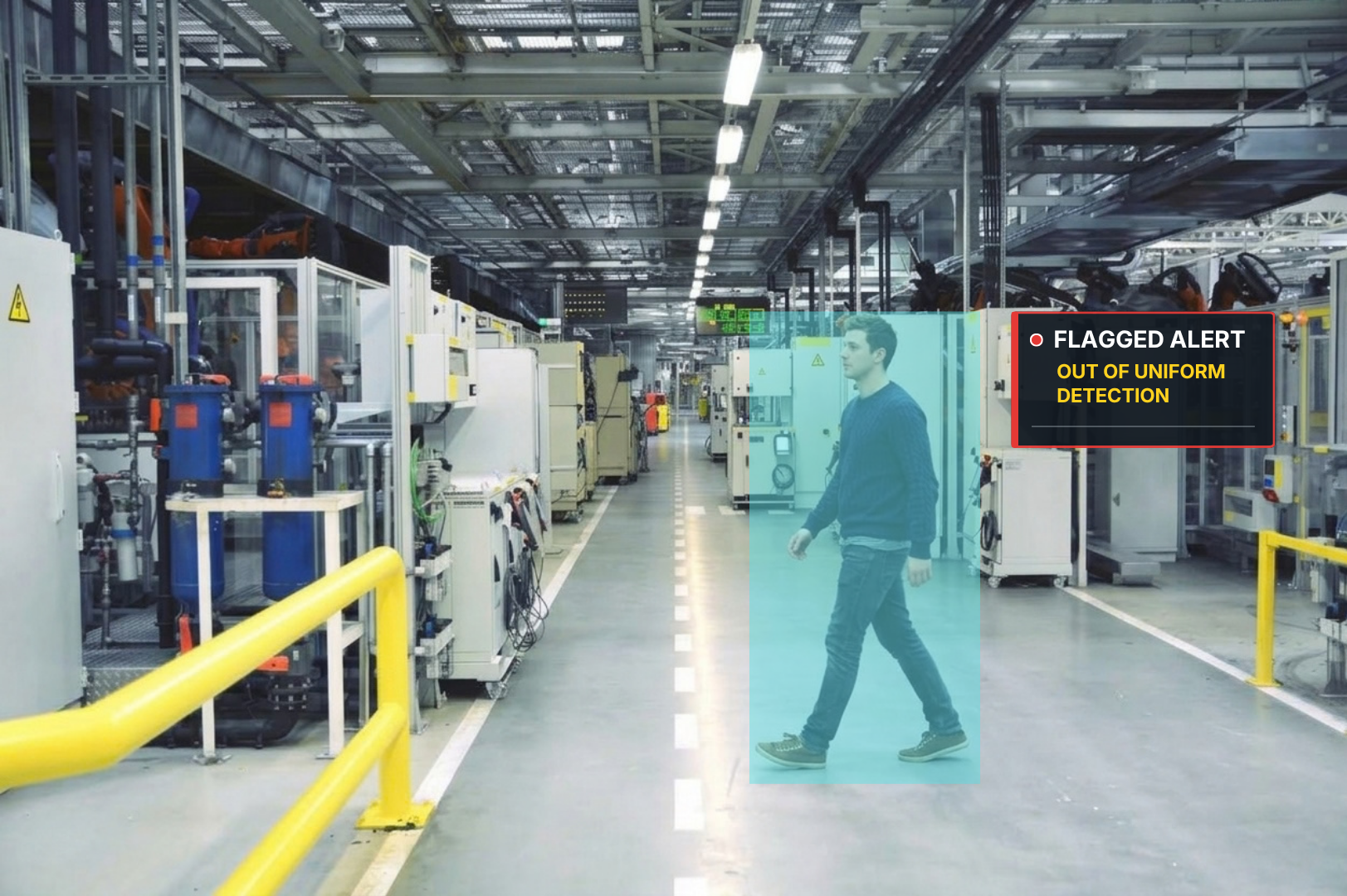
A uniform isn't about appearance — it's how a busy floor tells who belongs, who's trained, and who's protected. DICE spots the person out of uniform the moment they enter the frame.
What It Does
Out of Uniform Detection identifies people within a monitored area who are not wearing the designated uniform and sends alerts accordingly. It enforces the dress compliance that factories, hospitals, kitchens, and secure facilities depend on — where the uniform is inseparable from hygiene, protection, and access control. It also works in reverse: in employee-only areas, anyone not in uniform is by definition someone who shouldn't be there, making this a practical intrusion signal as well as a compliance tool.
The reference uniform is configured per site by color and type, so the system enforces your dress standard, not a generic one. A filtering process handles partial occlusion, posture changes, and shifting lighting, so a worker turning away from the camera or standing in shadow doesn't trigger an unnecessary event.
Who Uses It
Food Production & Commercial Kitchens
Uniform compliance is a hygiene control, not a style rule. DICE catches the missing smock or street clothes on the line before an auditor, or a contamination event, does.
- Street clothes and missing smocks flagged on the line before they reach the food or the auditor
- Continuous monitoring replaces spot-checks at shift start, which is usually the only time compliance gets verified
- Every violation logged with video for SQF and BRC food safety audits and customer audit documentation

Manufacturing Plants
A plant uniform often provides high-visibility and protective functions. A worker in street clothes on the floor is a safety risk, and DICE flags it in real time instead of waiting for the next walkthrough to find it.
- Missing high-visibility or protective uniform pieces flagged the moment they appear on the floor
- Contractors and visitors in non-compliant clothing identified before they reach hazardous areas
- Compliance record built automatically across every shift for safety audits and certifications

Hospitals & Healthcare Facilities
Scrubs and role-coded uniforms show who is clinical staff. DICE flags non-conforming clothing in controlled areas, where that visual signal is part of patient safety.
- Non-conforming clothing in clinical and controlled areas flagged automatically in real time
- Role-coded uniform rules set for each zone, with different standards for different areas of the facility
- Unauthorized people in restricted corridors identified when the correct uniform is missing

Secure Facilities & Staff-Only Zones
Flip the rule around: in back-of-house corridors, warehouses and restricted floors, a person who isn't wearing the company uniform triggers a DICE unauthorized-presence alert, with a face and a timestamp.
- Anyone in civilian clothing in a staff-only zone flagged immediately as an unauthorized presence
- Back-of-house corridors and restricted floors covered, even where there are no badge readers
- Every detection timestamped with video, creating a documented record of who was where and when

Safety & Compliance Managers
DICE replaces spot-checks at the door with continuous, camera-based enforcement and a video-backed compliance log for audits, certifications and customer inspections.
- Continuous enforcement replaces shift-start spot-checks that miss everything that happens afterward
- A video-backed compliance log ready for customer audits, certifications and regulatory inspections
- Trend data shows which areas, shifts and entry points have the most violations

How It Works
When someone out of uniform is detected in a monitored area, DICE alerts supervisors in real time, and one of our operators can deliver a live audio talk-down over on-site speakers, directing the person to gear up or leave the area. Every detection is logged with video, creating the continuous compliance record that manual door checks and periodic walkthroughs never could.

FAQs
-
The reference uniform is configured per site by color and type, so detection is matched to your actual dress standard rather than a generic template.
-
A filtering process is applied so that partial occlusion, posture, and lighting changes don't trigger unnecessary events — alerts fire on genuine non-compliance, not camera-angle accidents.
-
Yes. The rule applies in reverse: in areas reserved for employees, a person not wearing the designated uniform is flagged — turning dress compliance into a practical unauthorized-presence detector.